
Few things unsettle a homeowner faster than a damp patch that appears from nowhere. You’ve checked the pipes, inspected the roof, looked at the guttering — nothing is leaking. Yet the wall stays wet, and it’s getting worse. Across the UK, Ireland, and the Netherlands, where older housing stock, high rainfall, and cool winters create ideal damp conditions, this is one of the most common and most misdiagnosed building problems. The good news: a damp patch without a visible leak almost always traces to one of three causes, and once you identify which one, the fix is usually straightforward. This guide walks you through all three, how to diagnose each at home, and what actually works.
Quick Answer
What causes a damp patch on a wall when there’s no leak?
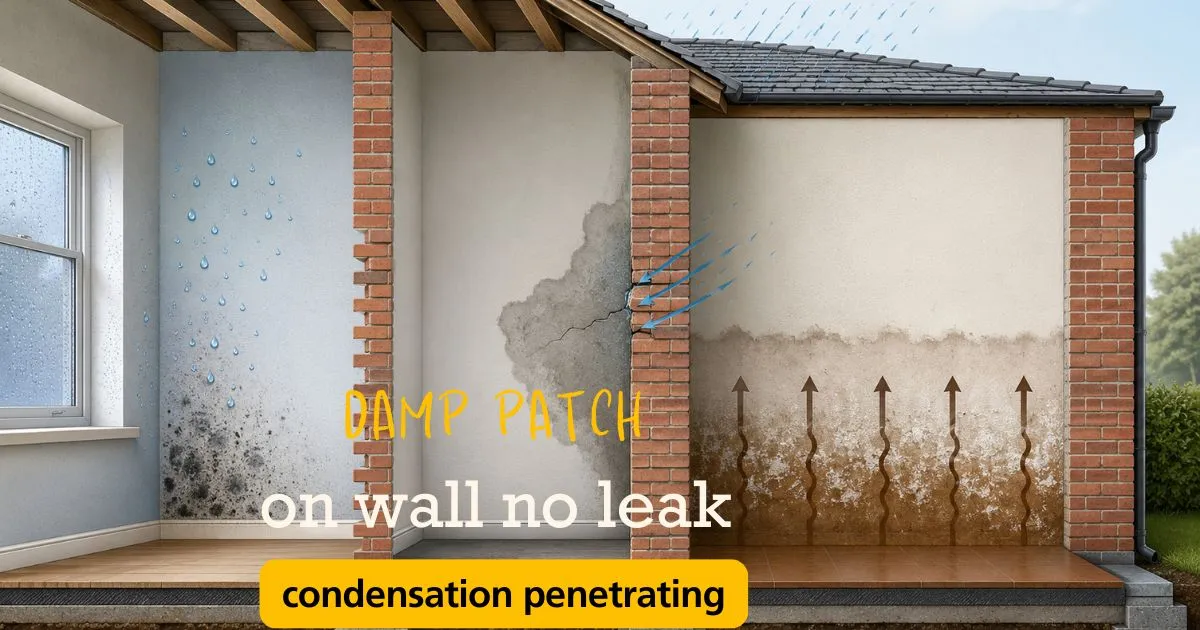
Three things account for nearly every case. Condensation — warm moisture-laden air meeting a cold wall surface — is the most common, especially on external walls in winter. Penetrating damp — rainwater entering through cracks in mortar, failed render, or faulty window seals — is second, typically appearing after heavy rain and drying between storms. Rising damp — groundwater climbing through masonry that’s lost its damp-proof course — is the rarest and most over-diagnosed, appearing only at ground level in a tide-mark pattern. Each has distinct visible signatures that separate it from the others.
Key facts at a glance:
- Most common cause: Condensation (especially in bedrooms, bathrooms, kitchens)
- Second cause: Penetrating damp (external wall defects letting rain through)
- Rarest cause: Rising damp (failed damp-proof course — ground floor only)
- Pipe leak ruled out? Check behind the wall too — hidden supply pipes and waste pipes can leak internally
- Mould present? Almost always confirms a moisture source — not just cosmetic
- Season matters: Winter-only patches = condensation; post-rain patches = penetrating
- Urgency: Not usually an emergency, but untreated damp damages plaster, decoration, and eventually timber
Is It Condensation? — The Most Common Culprit
Condensation is responsible for more unexplained damp patches than penetrating and rising damp combined, yet it’s the cause homeowners suspect least — because there’s no obvious water source. The water is already in your air.
Every occupied home produces moisture: breathing, cooking, showering, drying clothes, boiling kettles. Warm indoor air holds that moisture invisibly until it contacts a surface cold enough to turn it back into liquid — exactly the way water forms on a cold glass on a warm day. External walls, corners where two outside walls meet, areas behind furniture pushed tight against cold walls, and single-glazed window reveals are the surfaces where indoor air loses enough heat to dump its moisture.
The telltale signatures are distinct. Condensation damp typically appears on or near external walls, worst in winter when the temperature difference between warm indoor air and cold masonry peaks. It often concentrates in corners, behind wardrobes, and along ceiling lines where air circulation is poorest. Black mould — the spotty, surface-level growth that wipes off with a cloth — is condensation’s calling card; penetrating and rising damp produce different decay patterns. And critically, condensation patches tend to be widespread and vaguely defined rather than centred on a single sharp-edged wet spot.
The diagnosis test: pull furniture away from the affected wall and improve ventilation — open trickle vents, run extractor fans, and avoid drying clothes on radiators beneath the patch. If the damp visibly improves within two to three weeks, condensation was the cause.
The fix that works: the permanent solution addresses both sides of the equation — reduce the moisture you produce (extractor fans in kitchen and bathroom, vented tumble dryer or outdoor drying, lids on pans while cooking) and warm the wall surface so moisture can’t condense on it (adequate heating maintained at a low constant temperature rather than short blasts, improved wall insulation where possible, and furniture positioned at least 50mm from external walls to allow air circulation behind). Mould already present should be cleaned with a fungicidal wash — not bleach, which kills surface mould but doesn’t prevent regrowth — and the wall repainted with an anti-mould formulation once dry.
One overlooked cause of cold wall surfaces is a radiator that isn’t heating properly — a radiator cold at the bottom reduces the room temperature unevenly and creates the exact conditions condensation needs. If your radiators feel hot at the top but cold lower down, fixing that problem first may solve the damp without any further work.
Is It Penetrating Damp? — Rain Getting Through the Wall
Penetrating damp is external water — almost always rain — finding a path through the building envelope that isn’t supposed to exist. Unlike condensation, it originates from outside and works inward, and unlike rising damp, it can appear at any height on the wall.
The signatures separate it cleanly from condensation. Penetrating damp patches are usually sharply defined rather than vague, often worst after heavy or wind-driven rain and visibly drying between storms. They appear on the interior surface of external walls, frequently near windows, at junctions between different building materials, or below roofline features like parapets and chimney breasts. The affected plaster may feel cold and wet to the touch even in a warm room, and any mould growth tends to follow the path of water ingress rather than spreading diffusely across a wall.
The diagnosis test: note exactly when the patch appears or worsens, and correlate it with rainfall. A patch that darkens after every heavy rainstorm and lightens during dry spells is almost certainly penetrating damp. Check the external face of the wall directly behind the indoor patch — the entry point is usually visible from outside.
Common entry points to inspect outside:
Cracked, eroded, or missing mortar in brickwork joints. Failed or blown render that’s separated from the masonry behind it. Deteriorated sealant around window and door frames. Cracked or slipped roof tiles directly above. Blocked, overflowing, or leaking gutters and downpipes splashing against the wall. Damaged or missing flashing at chimney breasts, extensions, and lean-to junctions.
The fix that works: repair the external defect — repoint cracked mortar joints, patch or renew blown render, reseal window frames with external-grade silicone, clear or realign gutters, replace damaged flashing. Once the water path is closed, the internal patch dries naturally over weeks. Repainting before the wall has dried fully traps moisture and delays recovery. In exposed locations — coastal properties, west-facing walls in the UK and Ireland, windward facades in the Netherlands — applying an external masonry water repellent after repair adds a long-term protective layer without sealing the wall’s ability to breathe.
Is It Rising Damp? — Rarer Than You’ve Been Told
Rising damp is the most over-diagnosed damp problem in British and Irish housing — and also the most expensive to treat, which is why it’s worth understanding what it actually is before accepting a diagnosis.
Genuine rising damp occurs when groundwater is drawn upward through porous masonry by capillary action, in walls where the damp-proof course (DPC) — the waterproof barrier built into the wall near ground level — has failed, was bridged by external ground levels being raised above it, or was never installed (common in pre-1920s properties).
The signatures are specific. Rising damp appears only on ground-floor walls, never above roughly one metre in height, and creates a visible tide mark — a horizontal line across the wall where the moisture front stops. The plaster below the tide mark may be stained, salt-crusted (white crystalline deposits from mineral salts carried up by the water), and permanently damp regardless of season or weather. Unlike condensation, rising damp doesn’t respond to ventilation; unlike penetrating damp, it doesn’t worsen with rain.
The diagnosis test: if the damp is above ground-floor level, it is not rising damp — full stop. If it has no tide mark, no salt deposits, and varies with weather or season, it is almost certainly condensation or penetrating damp. Genuine rising damp is constant, low-level, and salt-stained.
The fix that works: a new chemical damp-proof course — injected into the mortar bed by a qualified damp-proofing contractor — replaces the failed barrier. The affected internal plaster must be hacked off, the wall allowed to dry, and replastered with a salt-resistant renovating plaster. External ground levels higher than the DPC must be lowered or a physical barrier installed. This is professional work, typically costing £1,500–£3,500 per affected wall in the UK, and it should come with a long-term guarantee — twenty to thirty years is standard from reputable contractors.
One honest warning: the damp-proofing industry has a documented history of misdiagnosing condensation as rising damp to sell unnecessary chemical treatments. If a surveyor diagnoses rising damp on an upper floor, in a patch that varies with weather, or without salt deposits and a tide mark — seek a second opinion from an independent chartered surveyor before committing to treatment.
FAQ — People Also Ask
Q: Can a damp patch appear without any leak at all?
Yes — condensation is the most common cause, and it involves no leak. Warm moist indoor air deposits water on cold wall surfaces without any plumbing or roof fault. Penetrating damp from external wall defects is the second-most-common non-leak cause.
Q: How do I tell condensation from penetrating damp?
Condensation is worst in winter, vague in shape, often accompanied by black surface mould, and improves with ventilation. Penetrating damp is sharply defined, worsens after rain, dries between storms, and traces to a visible external defect.
Q: Is a damp patch on the wall dangerous?
Not immediately, but untreated damp promotes mould growth (a respiratory health risk, especially for children and asthmatics), damages plaster and decoration, and can eventually affect structural timber. Fix the cause rather than repainting over it.
Q: How much does it cost to fix damp in the UK?
Condensation fixes (ventilation, insulation) cost £50–£500. Penetrating damp repairs (repointing, resealing) run £100–£800. Rising damp treatment (chemical DPC, replastering) typically costs £1,500–£3,500 per wall, and should include a long-term guarantee.
Q: Should I get a damp survey?
If you’ve ruled out condensation and can’t find an external defect, yes — an independent chartered surveyor (not a damp-proofing company offering free surveys) gives the most trustworthy diagnosis, typically for £150–£350.
Conclusion
A damp patch with no visible leak is almost always one of three things: condensation depositing airborne moisture on a cold wall, rain penetrating through an external defect you haven’t spotted yet, or — least likely but most expensive — rising groundwater climbing past a failed damp-proof course. Each leaves distinct signatures that a careful homeowner can read: season and weather correlation, patch shape and height, mould pattern, and the presence or absence of salt deposits.
Start with the likeliest cause: improve ventilation, pull furniture from the wall, and watch for two to three weeks. If nothing changes, inspect the external wall for cracks, failed mortar, and gutter faults. Only if neither explains it — and the patch sits at ground level with a tide mark and salts — does rising damp enter the picture, and even then, an independent surveyor’s opinion is worth more than a free survey from a company selling treatments.
The wall is trying to tell you something. Read the signatures, fix the cause, and the patch goes away for good.
And if you’re stuck waiting for a wall to dry out after fixing the damp, you’ll need something to listen to — these podcasts are a good place to start.